My bridge partner at university was studying how people group objects into conceptual categories and how the categories shift between people and languages. I remember having a deep conversation over tea about when a bowl becomes a plate.
 The objects he used to ask people to sort them into categories. From: http://hdl.handle.net/1842/5519
While AI is not new, using large language models within a business is new enough that we don’t have a shared conceptual framework for how to talk about it yet. If you search for “BI Stack”, for example, you will mostly get agreement that you have a data/input layer, data movement and transformations, and a visualization/output layer. If you search for “AI stack”, in contrast, the results are all over the place. With that in mind, I want to rate some of the “AI stack” diagrams that I found. These are all results from the last year.
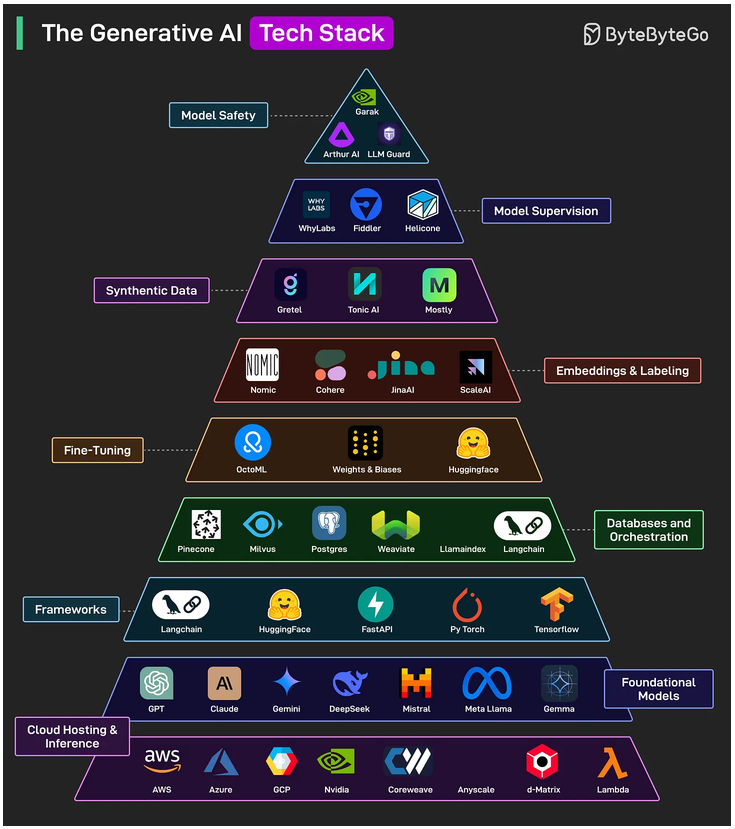
Let’s start with this one from the ByteByteGo newsletter. I like the design and the colour scheme, but the pyramid implies each level builds on the one below and I don’t find the groupings and ordering helpful. For example, why is synthetic data so high up? Who is supposed to be using that and for what? Synthetic data can be used to train foundational models but that has happened before the base of this pyramid. Also, what is frameworks supposed to contain? It seems like it is a mixture of wrappers for running open models and general coding libraries. Several logos appear in more than one layer, and at the top we have monitoring tools but nothing about apps or workflows. 4/10
 From: https://blog.bytebytego.com/p/ep171-the-generative-ai-tech-stack
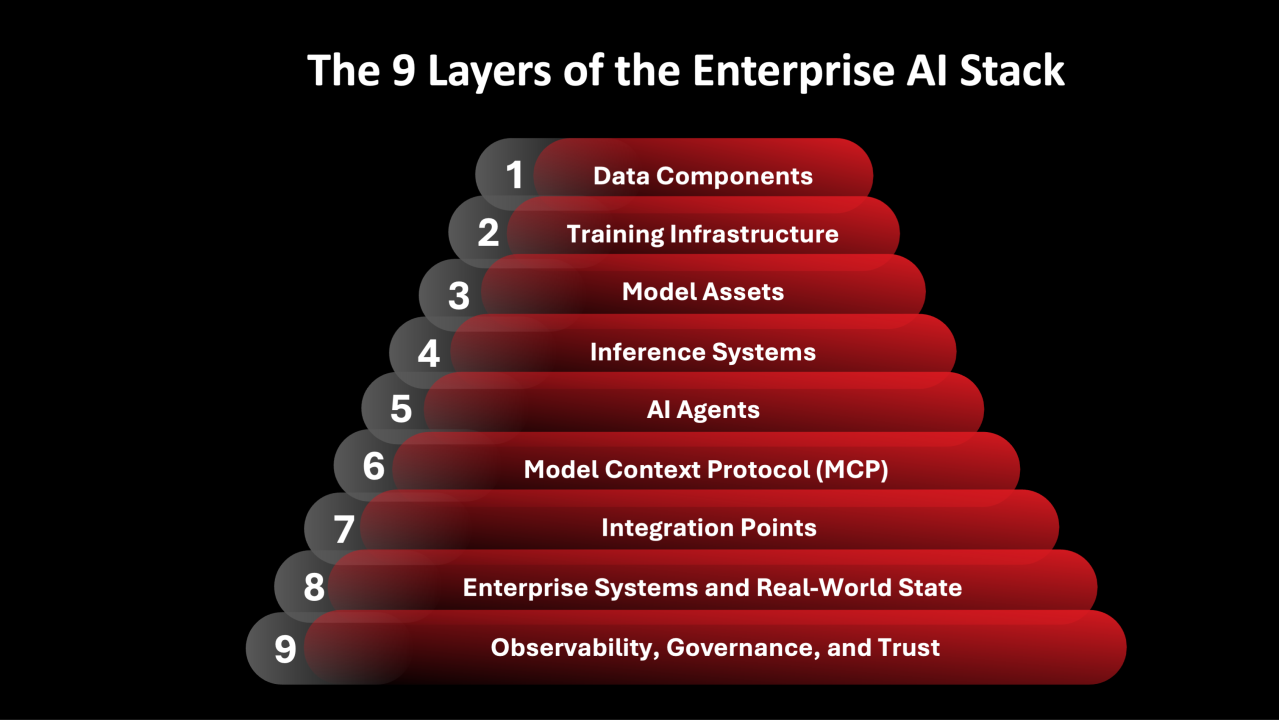
This next one also has nine layers, but completely different. The lowest one here, “Observability, Governance and Trust”, maybe matches to the top two from before (“Model Supervision” and “Model Safety”). “Model Assets” (3) is the same category of things as “Foundational models” above. The numbering is supposed to represent the step in the process from gathering the training data, through training the model through deploying it, though most organisations will not go through each of these steps since they don’t train their own models. Steps 4-7 are different ways you could use a model, not a linear progression (though perhaps increasing in complexity). The diagram does make sense in the context of the article which gives examples of the security threats you might encounter at each layer, but is surely not an AI stack. 6/10
 From: https://www.linkedin.com/pulse/9-layers-enterprise-ai-stack-understanding-how-created-castro-lpsze/
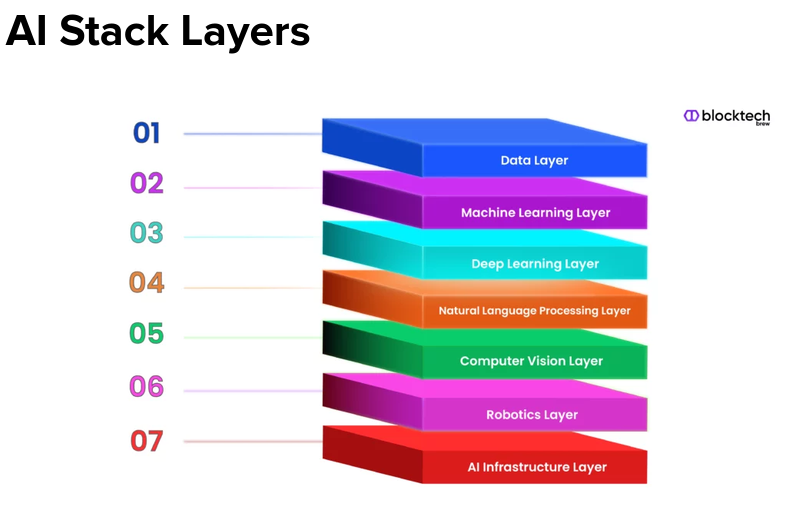
Another one also going for the layers but completely different again. The middle layers are just words associated with AI. If you actually review the context for this one it gets worse, so don’t bother. 2/10
 From: https://blocktechbrew.com/artificial-intelligence-stack-guide/
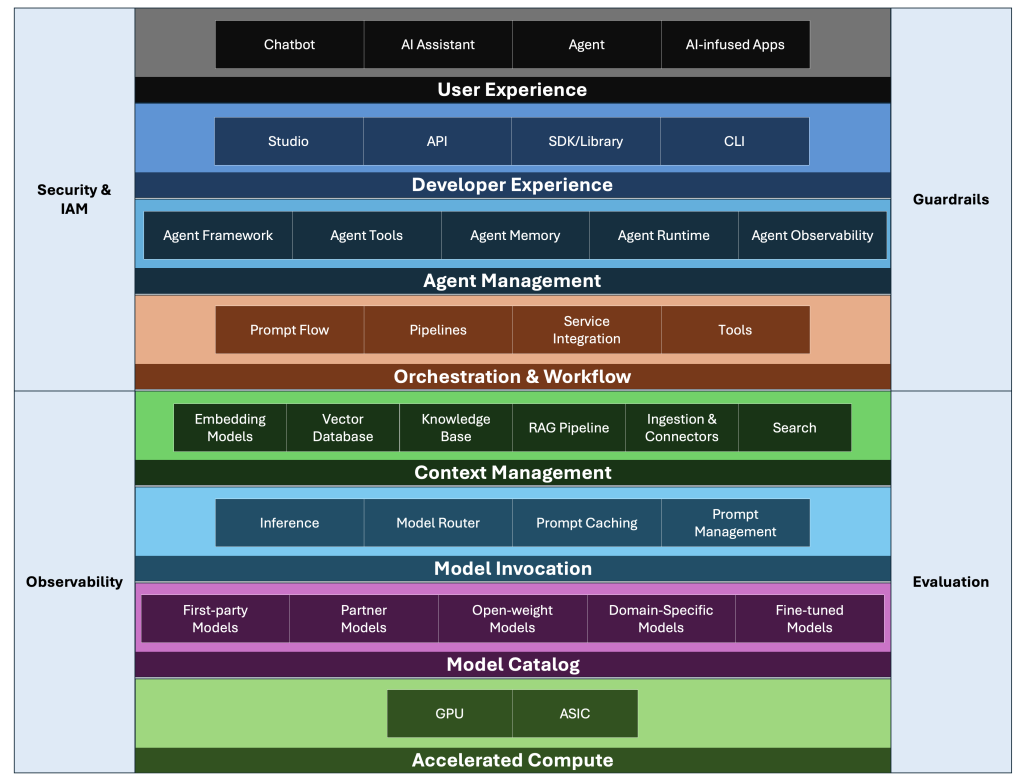
I like this one. The layers/groupings make important distinctions for a business production stack and I like how they are separated roughly into implementation and deployment, with the cross-cutting considerations for each. The article also follows this structure logically. It could be more beautiful but overall good effort. 9/10
 From: https://thenewstack.io/the-production-generative-ai-stack-architecture-and-components/
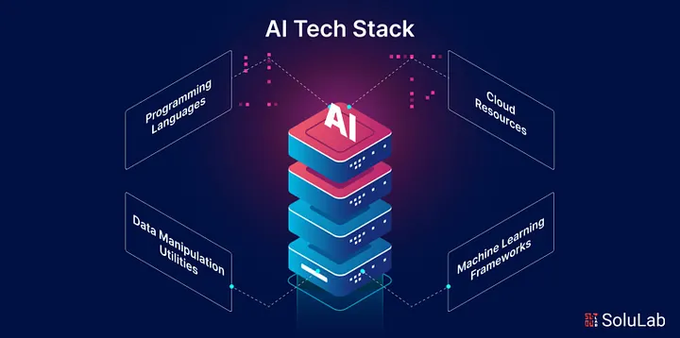
Another stack but the groupings don’t line up to the stack layers at all. This one is random buzzwords on an image. I’m struggling to see why these are the four things someone thought should be called out and it doesn’t match the article at all. I’ll give it a point because everything is spelled correctly. 1/10
 From: https://medium.com/aimonks/a-complete-guide-to-ai-tech-stack-fe9f428fabd6
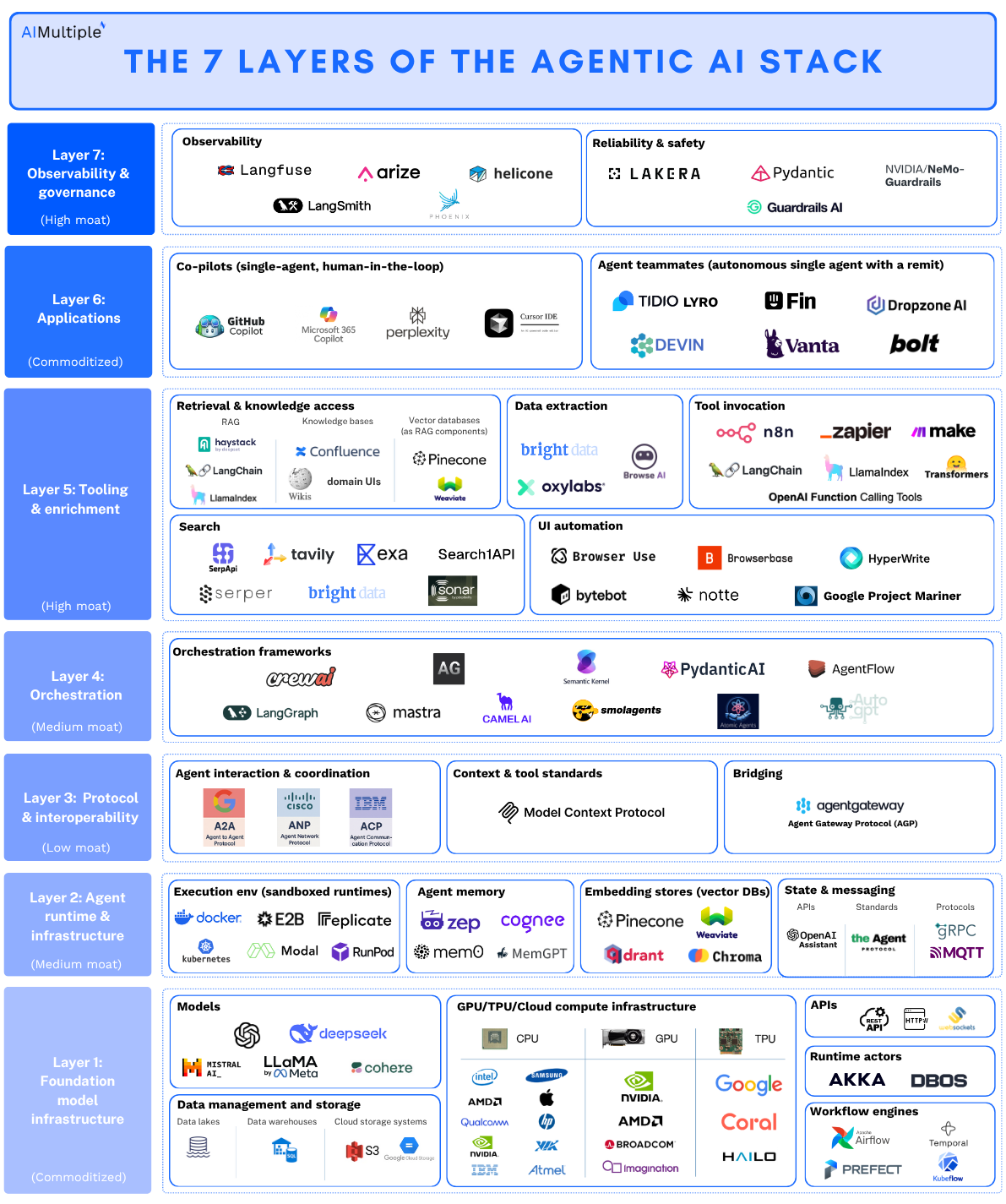
This one decided on seven layers, trying to call out which layers offer opportunities for “differentiation and moat building” vs which ones are “commoditized”. The big red flag here is that the article, while referring to the seven layers only references 6 layers in the first half, forgetting “protocol and interoperability”. I’m not a fan of these layers, what does “tooling” mean? that could be tooling for anything. There is not a tight logical progression in either direction and it is too busy. 3/10
 From: https://aimultiple.com/agentic-ai-stack
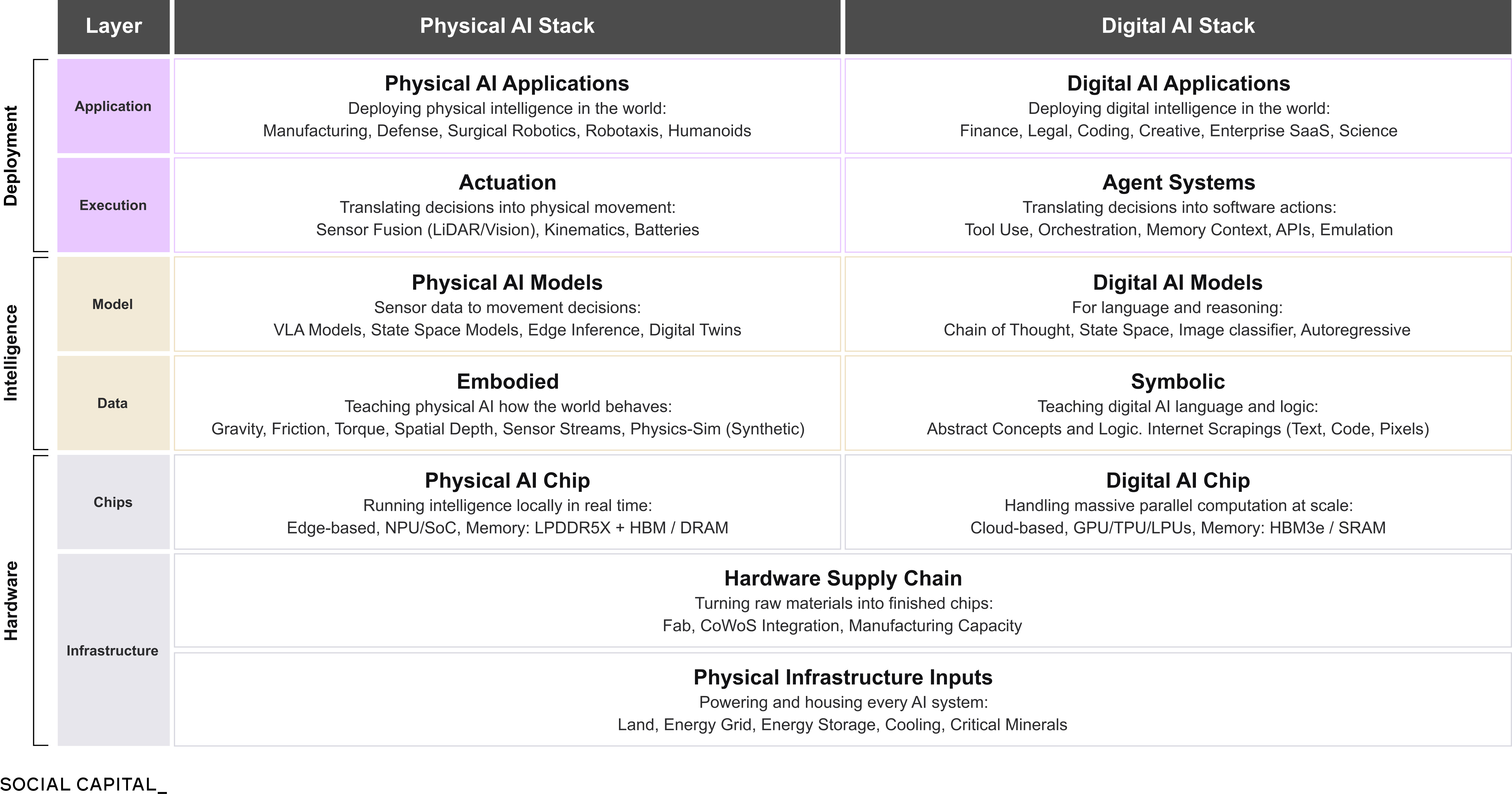
This one is from a post that specifically is trying to make a “conceptual stack for AI” to understand the field. The layers make sense in the context of training new models, but not for using models in a workflow. The physical vs digital distinction is getting at the difference between symbol manipulations/software applications VS robotics/engineering applications. I’m not convinced that is the right split but there is nothing egregious here. 6/10
 From: https://chamath.substack.com/p/the-ai-stack
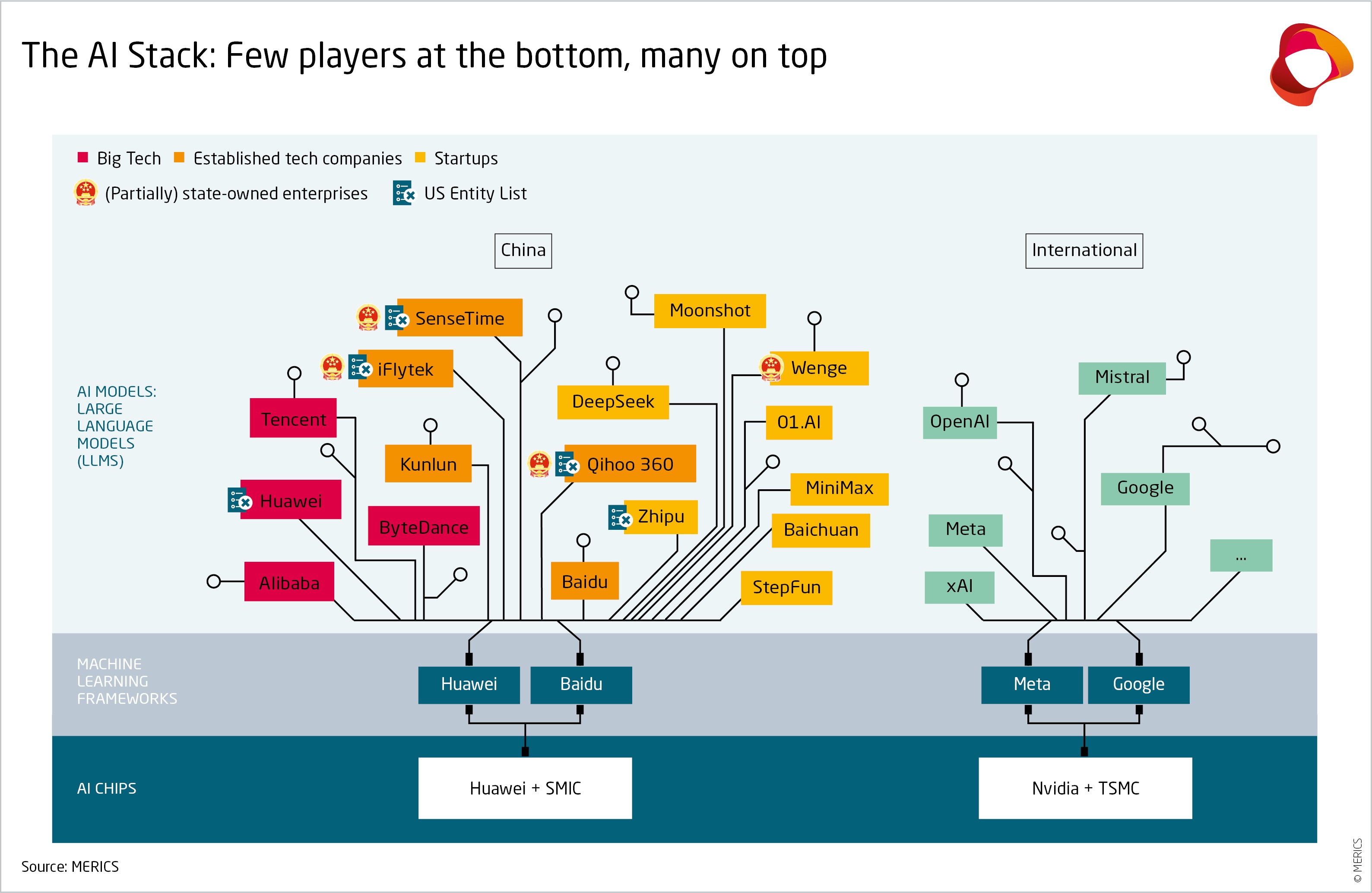
This one is interesting because it is a Chinese perspective on the landscape. Quite minimal with just 3 layers, the hardware, the “frameworks” and the models. Frameworks is a very broad category of “standard interfaces, libraries and toolkits for designing, training and verifying AI algorithms”, and it doesn’t include the business stacks that sit on top of these models. 4/10
 From:
From: This one is obviously AI-generated slop and so is the whole website, but I would like to see “Databaes” enter the lexicon. 0.1/10
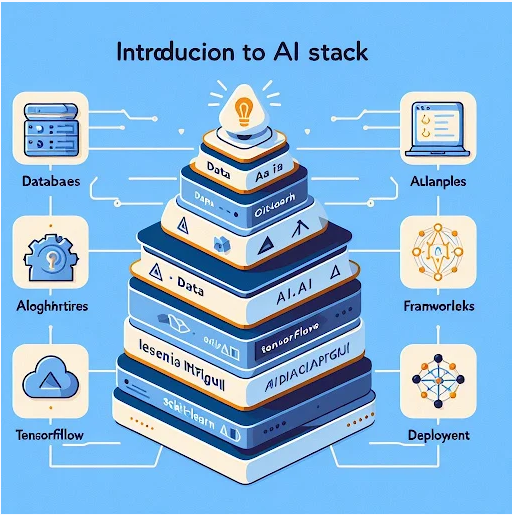 From: https://rejolut.com/blog/guide-to-modern-ai-stack/
There are a few things going on here.
First, “AI Stack” is used interchangeably to refer to the stack needed for creating a model and the stack needed for deploying a model, and many are mixing these functions into the same diagram (to be fair, there are businesses which might be involved in multiple of these).
Second, “Data” is a particularly muddled concept, with many diagrams not differentiating between data used to train the model initially, data used to better contextualize the input to a model and the general data that a business generates and manages.
Given that we still don’t 100% agree on what is a bowl vs a plate I’m sure this bemuddlement will be with us for a while but hopefully there will be slightly fewer confusing stack diagrams in the future.